New: the EU-compliant Digital Product Passport starter is live — try it. Book Demo

Compliance,
built into the product.

Meet EU Digital Product Passport requirements with structured, audit-ready product records designed to last.

Standardize product data
Capture information in structured formats aligned with EU ESPR requirements.
Integrated Certifications
Native support for FSC, GOTS, OEKO-TEX®, B Corp, and other leading standards. Easily add any custom certification required.
End-to-end traceability
Track products from production to end-of-life for full transparency.
EU Compliance
BUILT FOR DPP

From regulation
to infrastructure.

The EU Digital Product Passport introduces new obligations around transparency, traceability, and data accessibility. Meeting these requirements at scale requires more than documentation—it requires a system designed to capture, retain, and surface compliant product data over time.

AUTHENTICA provides the infrastructure layer that turns regulatory requirements into operational workflows, keeping product data accurate, verifiable, and aligned with EU expectations throughout the product lifecycle.

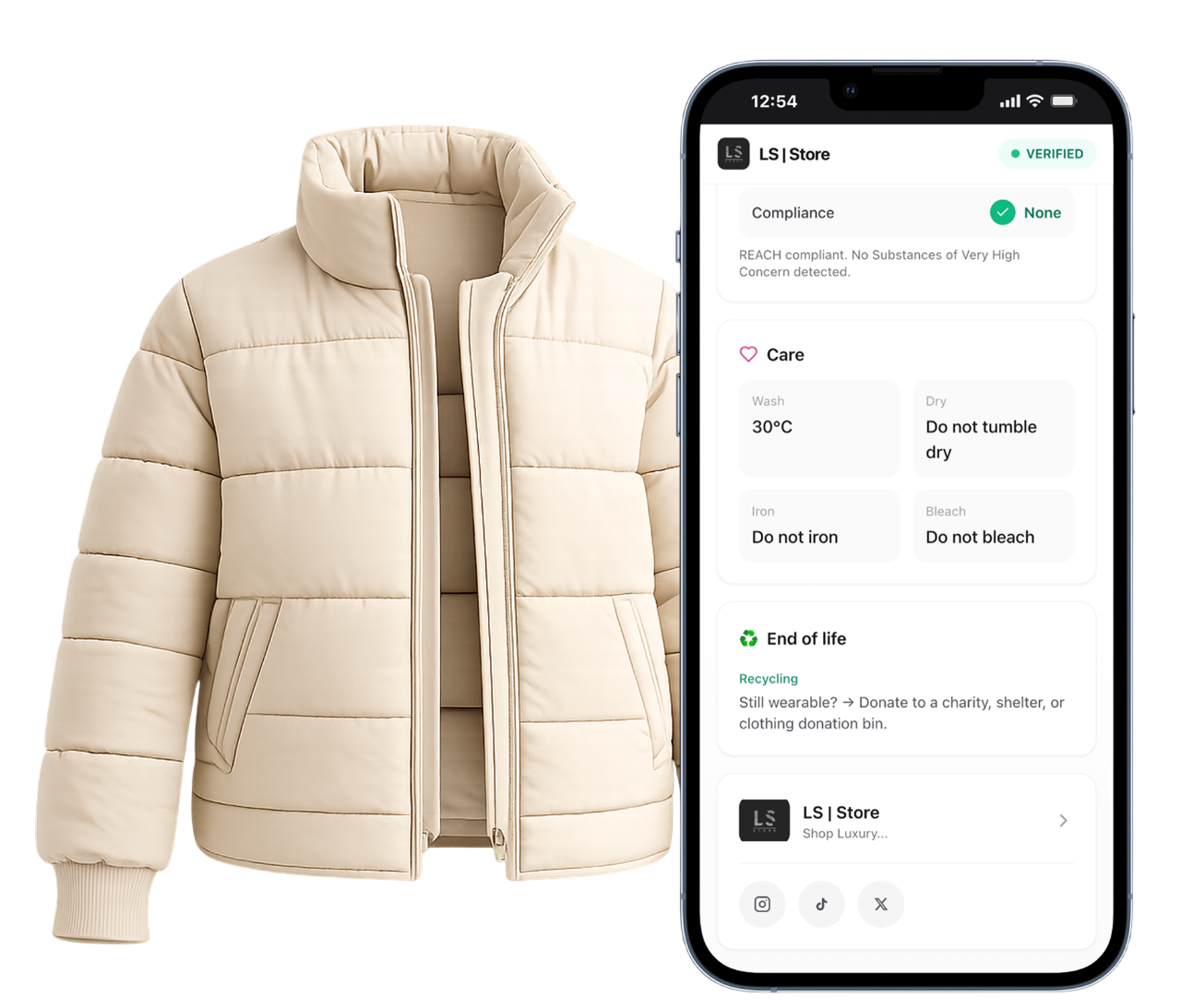
EU compliance DPP interface
Compliance-ready DPP record
ESPR COMPLIANCE

The DPP isn't a document.
It's proof.

From 2027, the ESPR Regulation requires every product sold in the EU to carry a verifiable Digital Product Passport: origin, materials, environmental impact, certifications. Declaring it is no longer enough — it must be demonstrable, accessible, and linked to the individual physical product.

With Authentica, you collect the required data once and make it available in real time to consumers, buyers, and distributors. Your certifications — GOTS, OEKO-TEX®, GRS, and 10+ global standards — become verifiable facts, not marketing claims.

DIGITAL PRODUCT PASSPORTS (DPP)

Everything ESPR requires,
already in the passport.

Origin, materials, certifications, environmental impact — structured to EU requirements and accessible to the right people, when they need it.

Standardized product data

The ESPR regulation requires structured data across 13 mandatory categories: material composition, carbon footprint, recycling instructions, origin, durability, repairability. With Authentica you collect it once in compliant fields — ready for consumers, buyers, and authorities. The platform automates collection and validation, reducing compliance preparation time by 40-60%.

Verified certifications

GOTS, OEKO-TEX®, GRS, FSC, REACH, and 10+ global standards are already built in. Link your certifications to the physical product and make them scannable by anyone — turning sustainability from a narrative into verifiable data.

Future-proof compliance

The ESPR Regulation introduces progressive deadlines: batteries from 2027, textiles and electronics (2028-2030). Starting now means building the right data structure before it becomes mandatory — and positioning ahead of competitors.

LET'S CONNECT

Book Demo

See how Authentica helps you launch EU-compliant Digital Product Passports, prove authenticity, and turn product data into trusted experiences—from start to finish.

Comparison: Digital Product Passport Approaches

How different DPP implementation approaches compare in terms of compliance, security, and scalability.

Feature Manual (Spreadsheets) Generic DPP Platform Authentica
ESPR Compliance Partial Yes Yes — auto-validation
Cryptographic NFC Authentication No Varies Yes — NTAG 424 DNA
Anti-Counterfeiting No Basic (QR only) Advanced — NFC + QR
Setup Time Weeks 2-4 weeks 2-4 weeks (pilot)
Cost per Unit Manual labor hours €0.10 — €1.00 €0.05 — €0.50
Consumer App No Varies Yes — iOS + Android
Scalability Limited Medium Unlimited

Frequently Asked Questions

When does the Digital Product Passport become mandatory?

The ESPR regulation (EU 2024/1781) introduces the DPP progressively: batteries from 2027, textiles and footwear to follow, with full coverage of most consumer goods by 2030.

What data must an ESPR-compliant DPP contain?

The DPP must include structured data on material composition, production origin, carbon footprint, durability, recyclability, and end-of-life instructions. The ESPR regulation requires 13 mandatory data categories.

How do you demonstrate compliance during an audit?

Authentica generates audit-ready records with timestamps, supply chain traceability, and verifiable documentation. Each data point is linked to the specific product's Digital Passport and accessible through the business panel.

What are the penalties for non-compliance with the ESPR regulation?

Penalties vary by EU member state but can include withdrawal of non-compliant products from the market, significant fines, and restrictions on sales within the European Union.