

Digital Product Passport in Football: How Empoli FC Integrated It Into Their Official Kits

Official kits are among the most iconic products in the world of sport. Yet from the club's perspective, they remain a blind spot: once sold, there is no way to know where they go, who owns them, or how they are used.
This limitation applies just as much to a Serie A team with hundreds of thousands of fans as it does to a lower-division club, a basketball franchise, or a tennis federation. The scale changes. The problem doesn't.
The Digital Product Passport was created to solve exactly this problem, turning every product into a traceable, verifiable, and connected object. And football is one of the contexts where its impact is most immediate.
How Empoli FC integrated the Digital Product Passport into their kits
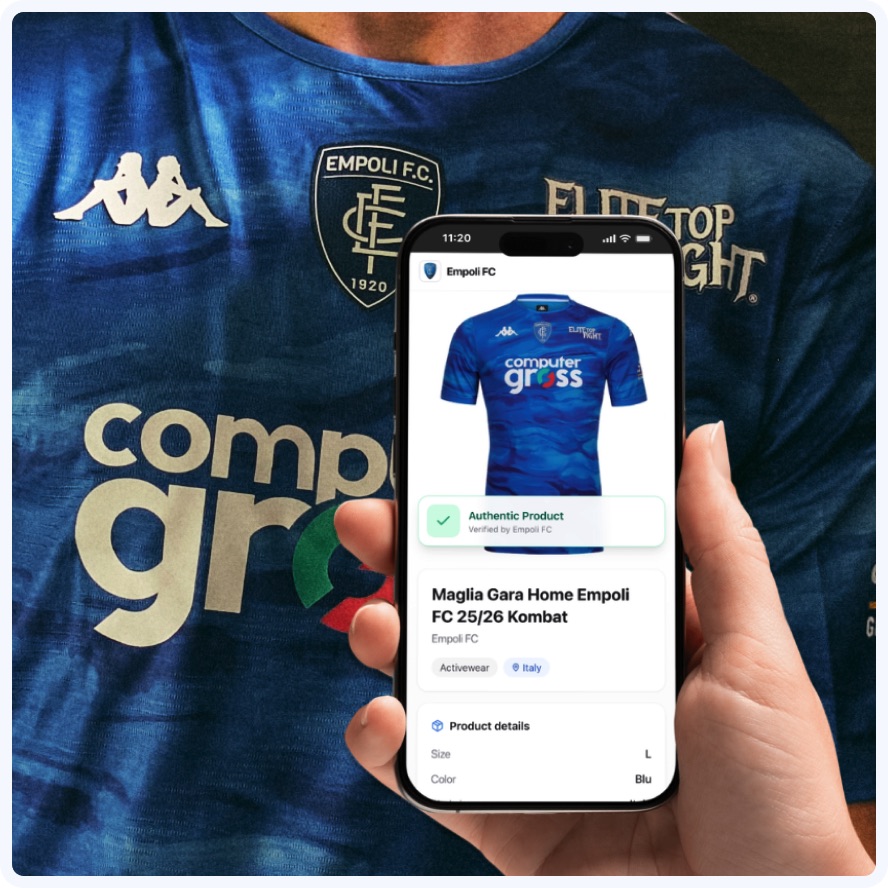
In the 2024/25 season, Empoli Football Club integrated the AUTHENTICA Digital Product Passport into their official match kits, unveiling them on the opening matchday of Serie A against Monza.
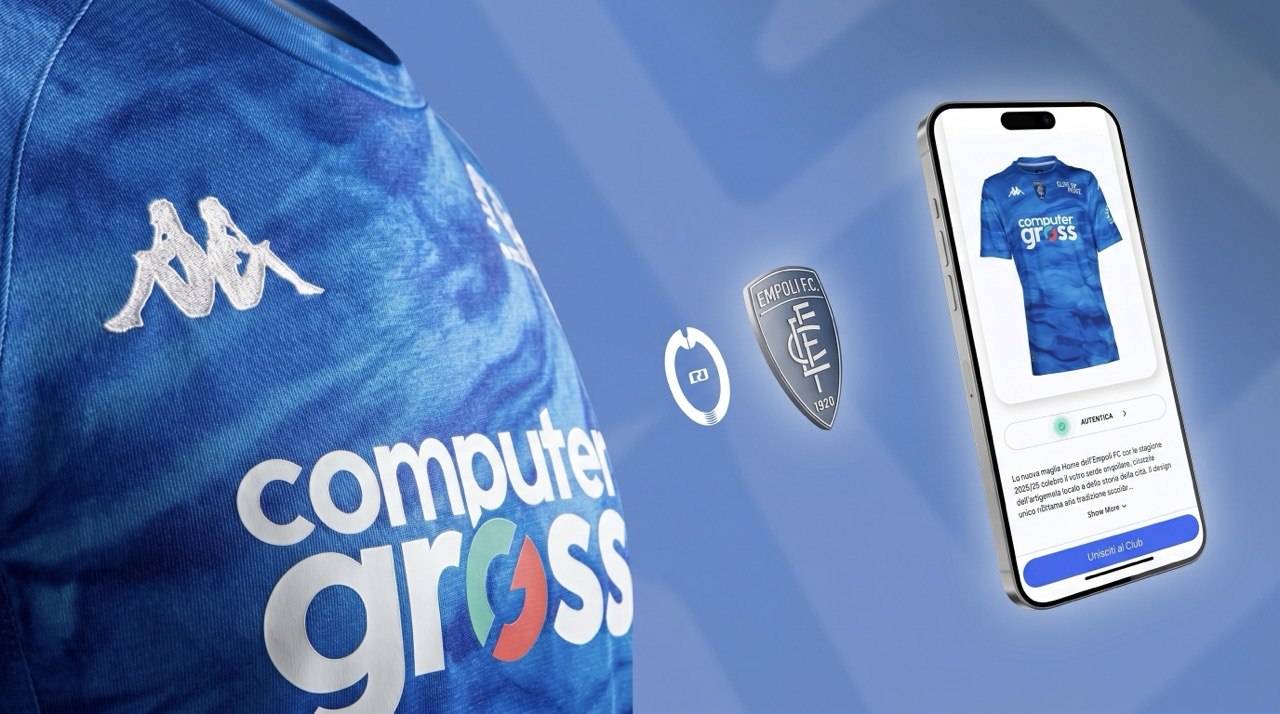
Every official kit includes an NFC smart tag embedded directly under the club crest. With a single tap of the smartphone, the fan accesses a digital experience tied to the physical product, creating a direct link between the object and its digital identity.
The project, renewed for the 2025/26 season, turned a one-off activation into an operational standard. This is a key shift: the Digital Product Passport was not treated as an accessory feature, but as a structural part of the product itself.
What makes a kit verifiable: inside the Digital Product Passport
The digital passport documents the origin of the kit, from the materials used to the production process, all the way to the certificate of authenticity. Every product is bound to a unique digital identity, designed to be non-replicable.
This addresses a clear limitation of current systems. A QR code can be copied and reused. A printed certificate can be forged. In both cases, verification rests on static elements that are easy to bypass.
A secure NFC tag introduces a fundamentally different logic: it can embed dynamic authentication mechanisms that make cloning attempts ineffective, shifting the concept of authenticity from trust to verification. For a technical comparison of the two data carriers, see our NFC vs QR code guide for the DPP.
Supply chain transparency
In line with the Digital Product Passport requirements introduced by the ESPR regulation by 2027, the system includes information on the production chain — from material composition to manufacturing practices — turning the project from a marketing activation into an infrastructure already aligned with EU regulatory compliance, ahead of a scenario that will become mandatory across the entire textile sector.
A direct channel with the fan
After tapping the tag, the kit's owner gets access to a direct communication channel with the club. Not generic content, but activations built for an audience that has already shown a concrete connection to the brand.
This dynamic enables the club to develop more relevant interactions — content tied to specific matches, exclusive access, dedicated initiatives, or stadium experiences. The product becomes an active touchpoint, capable of extending the relationship well beyond the moment of purchase.
The Empoli FC case shows how the Digital Product Passport can be applied outside luxury and fashion while keeping the same logic intact: physical product, digital identity, direct channel with the owner. Discover how the platform works →
Why football is one of the best-fit contexts for the DPP
Official kits from sports teams have characteristics that make them a particularly strong fit for the Digital Product Passport — more so than many other textile products.
Their economic value is often high, and the counterfeiting risk is real, especially for limited-run releases: the replica market is structured and increasingly difficult to spot by sight, making an authentication solution accessible directly to the end user a necessity. The real cost of counterfeiting in textiles shows why per-unit authentication is no longer something brands can postpone.
Anyone buying an official kit is not a generic consumer, but an active fan who has already shown a concrete bond with the club and is far more likely to interact with the product after purchase. Kits change every season, creating a continuous flow of new products and new opportunities for activations and gamification among verified owners.
The DPP as the foundation of the product infrastructure
One of the most relevant aspects of the Empoli FC case is its continuity: the adoption across two consecutive seasons shows that the Digital Product Passport was not used as a communication asset, but as the structural backbone of the product.
Through the DPP, the club reaches the kit owners with targeted content and offers, linking the physical product to its digital identity and enabling a direct channel with the fan. Clubs that start building this infrastructure today gain a double advantage: on one side, they prepare for European compliance; on the other, they develop a direct relationship channel that does not depend on external platforms or algorithms.
What other clubs can do starting from this model
The model implemented with Empoli FC is replicable and doesn't require special conditions. The value of the Digital Product Passport does not depend on the size of the audience, but on the quality of the relationship with fans. Even smaller organizations can capture concrete benefits.
The NFC tag integration happens at the physical product level and is compatible with different chip manufacturers. Implementation can start from a single product line, such as the official kits, and later extend to other merchandise categories.
It's a system designed to evolve, where content and activations can be updated even after the sale, allowing the product to generate value over time.
The DPP in sport is not the future — it's already operational
The Empoli FC case proves that the Digital Product Passport is already a concrete reality in the world of sport. A technology that isn't reserved for luxury or fashion, but an infrastructure that can be applied today, capable of improving authenticity, fan relationships, and regulatory readiness.
Want to see how to apply a Digital Product Passport to your products or your club?
Let's look at a concrete case on your official kit line or merchandise range together.
Get your free assessment →Frequently asked questions on DPP implementation
Is the DPP already mandatory for sports clubs?
No. The ESPR regulation schedules the mandatory introduction of the Digital Product Passport in the textile sector by 2027, and sports kits fall fully within this category.
What happens if a fan doesn't have an NFC-enabled phone?
A QR code can be paired with the NFC tag to ensure accessibility for all users, though with lower security guarantees than cryptographic NFC authentication.
Does it work in the second-hand resale market?
Yes. The DPP is linked to the product, not to its owner, and stays with the kit even after resale, ensuring continuous authentication and traceability.
How long does implementation take?
For a single product line like the official kits, implementation timelines are compatible with the seasonal kit launch cycle.
Can it integrate with CRM and ticketing?
Yes, as a natural evolution of the project. Integration with CRM, ticketing, and loyalty systems turns the kit into an access point to the club's entire digital ecosystem.
Bring the Digital Product Passport to your kits
Discover how AUTHENTICA helps sports clubs and technical brands turn every kit into an authenticated, traceable product, connected to the fan.
Book a Demo →