

Digital Product Passport for Handbags & Leather Goods: From Trust to Proof

A customer buys a handbag for €400. She's told it's made with Italian calfskin, hand-stitched and vegetable-tanned, and she believes it because the brand says so.
What she doesn't have is a way to verify any of it. The certificate in the box is just a piece of card, the “Made in Italy” label could be on anything, and if she resells the bag in two years, the next buyer has even less to rely on.
This is the gap the Digital Product Passport is designed to close. It connects structured, verifiable data directly to the product — using an NFC tag or a QR code embedded in the product — accessible with a simple tap and available for as long as the product exists.
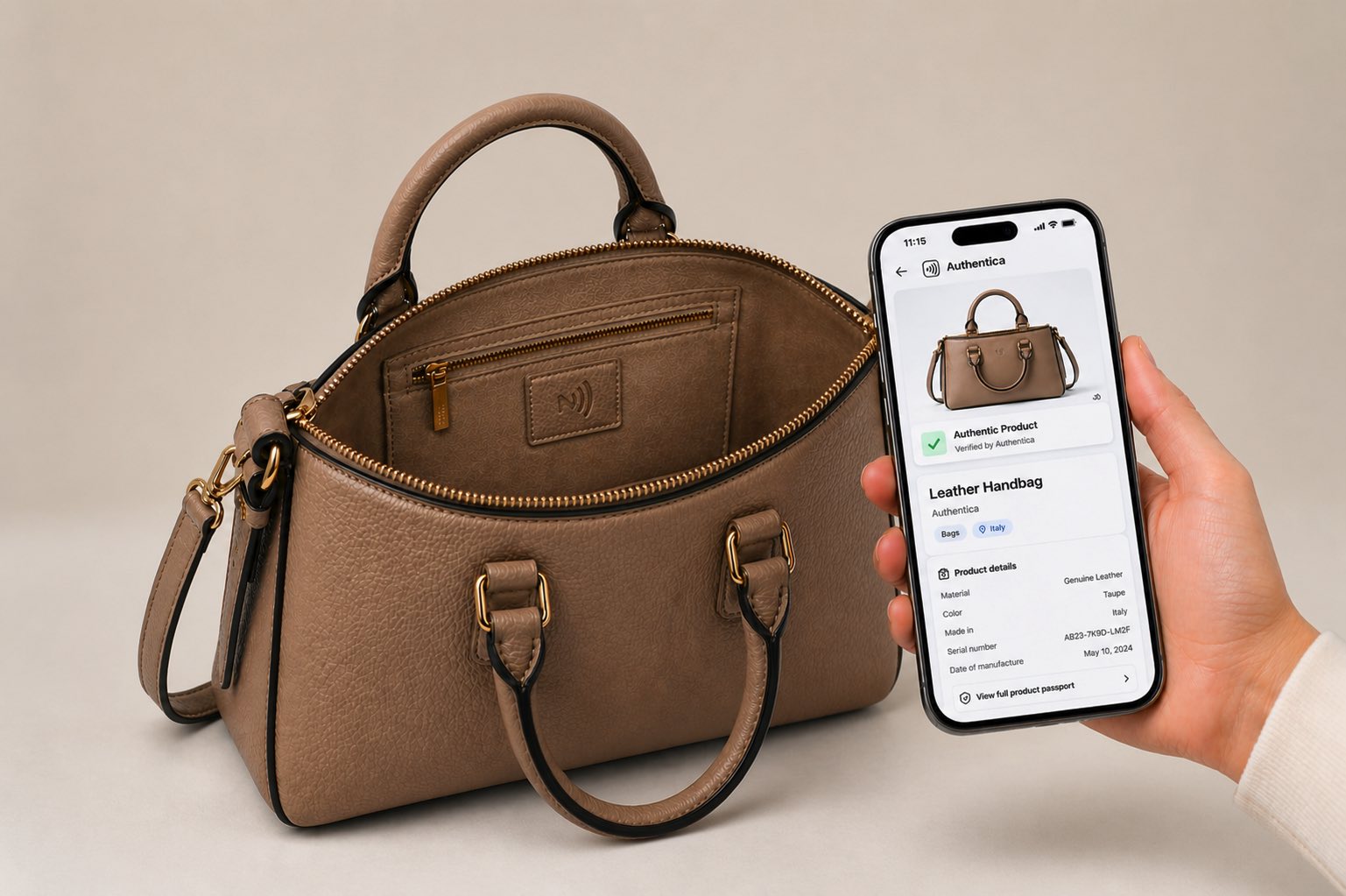
What the customer actually sees
An NFC tag is integrated into the product, inside a label, a leather patch, or the lining of a bag, jacket, or accessory. The customer taps her phone against it without needing an app or an account.
What opens is the product's digital identity: materials and certifications, production method, origin, key features, along with a real-time authenticity check, all tied directly to that specific item.
The level of detail depends on the brand. Kilesa, an Italian leather goods brand from Caserta, uses it to verify the origin and quality of their calfskin bags, which becomes particularly relevant when selling through international retailers far from the workshop where the product was made. YOVA, a Macedonian brand working with hand-crocheted raffia and plant-based vegan leather, uses it to make sustainability claims tangible rather than decorative. Caresta, whose roots trace back to a leather factory founded in 1849, uses it to carry the product's heritage and provenance with the object itself. Elitter, a high-end fashion house specialised in leather garments, has embedded the passport directly into its creations — from jackets to accessories — making authenticity, materials, and provenance verifiable on every piece with a simple tap.
Different brands approach it in different ways, but the underlying mechanism remains the same.
The verification problem in leather goods
Leather goods — from handbags to jackets and small accessories — share a credibility issue that most product categories don't.
The elements that define value are often invisible. Full-grain calfskin versus bonded leather, plant-based materials versus synthetic PU, Italian tanning versus imported, hand-stitched versus machine-assembled. These differences can justify price gaps of hundreds of euros, yet they are almost impossible for a customer to verify by simply looking at the product.
Traditional authentication methods don't solve this in a reliable way. Certificates, serial numbers, or holographic patches can all be replicated or detached from the product itself. The cost of counterfeiting goes well beyond lost revenue: it erodes brand equity, customer trust, and market positioning. And traditional methods show that something was issued, but they don't prove that it is still connected to the physical item.
NFC with dynamic authentication works differently. The chip generates a unique response at each scan, which is verified in real time. Copying an identifier is not enough, because without the physical chip the verification fails. In a category where high-quality counterfeits are increasingly common, this changes the level of trust that can be established.
For handbags and leather goods, the value is in details the customer cannot see. The Digital Product Passport turns invisible quality into verifiable proof, tied to that specific item. Discover how the platform works →
Beyond authentication: what the DPP enables
Authentication is only part of the picture.
The Digital Product Passport also creates a direct channel between the brand and the product owner. Not followers or newsletter subscribers, but the person who actually bought the piece and has it in their hands. Through this channel, brands can share care instructions, notify about new collections, offer repair services, or build loyalty initiatives tied to the product itself. This direct connection between product and owner is one of the core capabilities of a well-designed DPP platform.
For brands that invest heavily in craftsmanship and materials, this addresses a familiar issue. The story behind the product tends to disappear after the sale. Hang tags are removed, product pages get lost, and the narrative that justifies the price fades quickly.
The DPP keeps that information connected to the product over time, making it accessible when it actually matters.
Why leather goods are a natural fit
Not every product category benefits in the same way from a Digital Product Passport, but leather goods bring together several conditions that make the implementation particularly effective.
The unit value is high enough for customers to care. Someone who spends several hundred euros on a leather piece is more likely to engage with the product and want reassurance about what they are buying.
The product lifecycle is long. A well-made leather item stays in use for years, often moving between owners, and the passport follows it while maintaining its verified identity.
Materials are central to the value of the product, yet they are difficult to verify visually. This is where the gap between what is claimed and what can be confirmed becomes most evident.
At the same time, the risk of counterfeiting is concrete and growing. Replica handbags and leather garments are among the most counterfeited products globally, and traditional methods struggle to keep up. NFC-based authentication introduces a level of verification that is harder to replicate and easier to access for the end user. For brands operating in the luxury segment, the DPP also plays a key role in anti-counterfeiting strategy.
The regulatory timeline
The EU's Ecodesign for Sustainable Products Regulation (ESPR) will require Digital Product Passports for textile products sold in the European market starting in 2027, and leather goods fall within this scope. Brands in the fashion and textile sector can find a full breakdown of requirements in our ESPR compliance guide.
Implementing today is not only about addressing current challenges, but also about building the infrastructure that will be required for compliance. This includes data structures, supply chain visibility, and technical integration. Starting earlier gives brands the time to refine the system before it becomes mandatory.
Want to see how a DPP would work on your leather goods collection?
Let's look at a concrete case on your line together — bags, jackets, accessories — from materials and certifications to authentication and customer engagement.
Get your free assessment →Frequently asked questions
Is the DPP already mandatory for leather goods?
Not yet. The ESPR regulation targets 2027 for textile products, and leather goods fall within this scope.
Where does the NFC tag go on a leather product?
Typically inside labels, leather patches, the lining of a bag, or discreet placements in jackets and accessories, so that the customer can tap the product without affecting its design.
Does the DPP survive resale?
Yes. It is tied to the product, not the owner, and stays with the item through every resale.
What does the customer need to scan it?
A smartphone with NFC. No app or account required.
Can it be added to existing products?
Yes, both during production and on existing inventory, depending on the product format and supply chain setup.
The brands already using the Digital Product Passport on their leather goods are not doing it because of regulation. They invest in materials, craftsmanship, and process, and until now their customers had no reliable way to verify that work.
The DPP makes that visible.
Bring the Digital Product Passport to your leather goods
Discover how AUTHENTICA helps handbag and leather goods brands turn every product into an authenticated, traceable item, connected to the customer who owns it.
Talk to us →